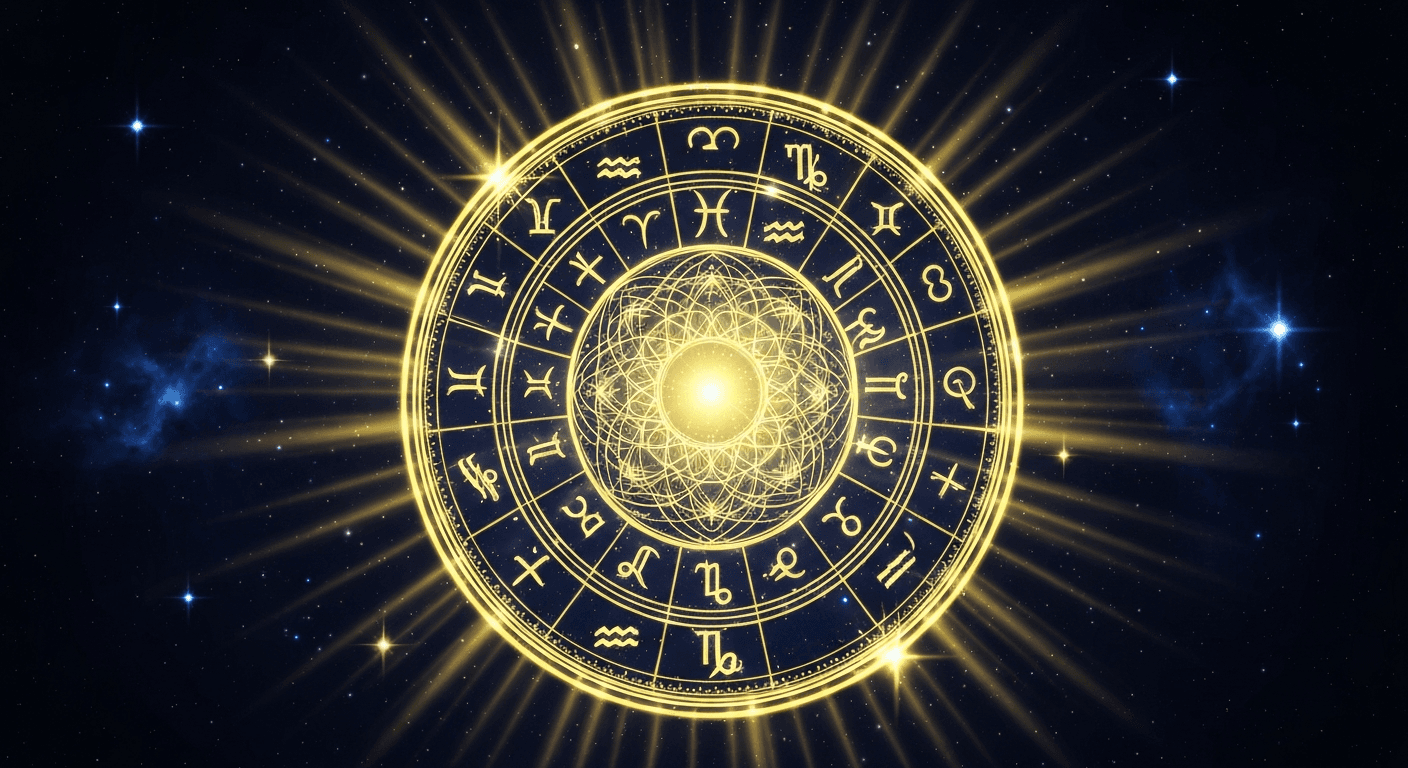
Your birth chart — or Kundli — is a precise map of the sky at the moment of your birth. This guide explains the 12 houses, planetary meanings, your Ascendant, Moon sign, and how to begin reading your own chart.
What Is a Birth Chart?
A birth chart — called a Kundli in Sanskrit, or Janam Patrika — is a precise astronomical map of the sky at the exact moment of your birth, drawn from the perspective of your birthplace. It records which zodiac sign was rising on the eastern horizon, where the Sun and Moon were positioned, and where each of the nine Vedic planets fell within the twelve signs of the sidereal zodiac.
In Vedic astrology, the birth chart is understood as a karmic blueprint — a snapshot of the cosmic configuration that shaped the conditions of your incarnation. It describes not just who you are in terms of personality and tendencies, but the arc of your life: the domains where growth will be easiest, the areas where challenge and transformation are built into the journey, the timing of major chapters, and the deeper purposes the soul has come to explore.
Reading a birth chart is a skill that takes years to master in full depth, but understanding its basic architecture is accessible to anyone willing to engage with the framework. This guide walks you through the essential components.
The Basic Architecture: Signs, Houses, and Planets
A birth chart is built from three fundamental layers that interact to create a unique picture:
Signs (Rashis): The twelve zodiac signs represent qualities, modes of expression, and elemental energies. They describe how a planet expresses its energy. Aries is fiery, direct, and initiating; Libra is airy, relational, and balancing; Scorpio is fixed water — intense, transformative, and deep.
Houses (Bhavas): The twelve houses represent the twelve domains of life — from identity and wealth to career and relationships. They describe where a planet's energy is most prominently expressed in your life circumstances. A planet in the 2nd house primarily influences wealth and family; the same planet in the 7th house primarily influences partnerships.
Planets (Grahas): The nine Vedic planets are the actors — the sources of specific types of energy, motivation, and experience. The Sun is the soul and the father; the Moon is the mind and the mother; Jupiter is wisdom and expansion. They describe what kind of energy is active.
The chart is read by understanding which planet is in which sign, in which house — and then interpreting how those three layers interact.
The Ascendant: Your Window on the World
The Ascendant (Lagna) is the zodiac sign rising on the eastern horizon at the moment of your birth. It is the most time-sensitive component of the chart — it changes approximately every two hours, which is why an accurate birth time is essential for precise Vedic chart reading.
The Ascendant is the first house of your chart and establishes the entire house system. It is your primary lens of identity — not who you are in your deepest essence (that is the Sun), not how you feel and respond emotionally (that is the Moon), but how you encounter the world, how the world encounters you, your physical constitution, and your overall orientation to life.
- ◆An Aries Ascendant brings a direct, energetic, initiative-driven quality to the personality.
- ◆A Cancer Ascendant brings sensitivity, nurturing, and a strong connection to home and family.
- ◆A Capricorn Ascendant brings discipline, practicality, and a patient, measured approach to life.
The ruler of the Ascendant sign is called the chart ruler or Lagna lord, and its condition — the sign it occupies, its house placement, and its relationship with other planets — is one of the most important factors in the entire chart.
The 12 Houses Explained
Each house governs a specific domain of life. Understanding the houses is foundational to reading any chart:
1st House (Lagna): The self, physical body, overall life direction, personality, and first impressions. The sign on this house is your Ascendant.
2nd House: Accumulated wealth, family of origin, speech, food, values, and early childhood. Planets here influence how you earn and hold resources.
3rd House: Courage, initiative, communication, siblings, short journeys, skills, and effort. A strong 3rd house supports boldness and effective communication.
4th House: Home, mother, emotional foundations, property, vehicles, and inner contentment. This house describes the quality of your private life.
5th House: Intelligence, creativity, children, romance, spiritual merit from past lives (Purva Punya), and speculative ventures. One of the most auspicious houses.
6th House: Health, daily service, obstacles, enemies, debts, and the capacity to overcome challenges. A strong 6th house lord supports resilience.
7th House: Marriage, business partnerships, contracts, and the public projection of self. The 7th describes not just romantic partnership but all significant one-to-one relationships.
8th House: Longevity, transformation, inheritance, hidden knowledge, sudden changes, and deep investigation. One of the most complex houses — associated with both crisis and profound awakening.
9th House: Fortune, dharma (right action), higher education, father, long journeys, philosophy, and spiritual teacher. One of the most auspicious houses — the house of blessings.
10th House: Career, professional reputation, public life, authority, and the primary purpose in the outer world. The house of action and achievement.
11th House: Gains, elder siblings, social networks, the fulfillment of desires, and income beyond the salary. The most directly wealth-related of the angular houses.
12th House: Liberation (Moksha), foreign residence, hidden expenditure, spiritual retreats, and the dissolution of the ego. Associated with both loss and profound spiritual attainment.
Planets and Their Core Meanings
Each of the nine Vedic planets carries a specific quality of energy that colours whatever house and sign it occupies:
Sun (Surya): Soul, vitality, father, authority, and the central purpose of the incarnation. A strong Sun supports leadership, confidence, and clarity of purpose.
Moon (Chandra): Mind, emotions, mother, the public, and habitual responses. The Moon's sign and house describe your emotional landscape and what you instinctively seek for comfort and security.
Mars (Mangala): Energy, drive, courage, and the capacity for decisive action. Mars also governs property, siblings, and physical vitality. A well-placed Mars gives initiative and strength; a challenged Mars can bring conflict or impulsiveness.
Mercury (Budha): Intelligence, communication, analytical ability, and trade. Mercury's condition indicates the quality of the mind and the ease of expression.
Jupiter (Guru): Wisdom, expansion, generosity, children, and dharma. Jupiter is the great benefic — its presence and aspects generally bring growth, opportunity, and protection.
Venus (Shukra): Beauty, pleasure, arts, relationships, luxury, and the capacity to enjoy life. Venus governs how you attract and experience love and abundance.
Saturn (Shani): Discipline, karma, delay, longevity, and service. Saturn teaches through challenge and restriction, but ultimately rewards patience and integrity with enduring achievement.
Rahu (North Node): Worldly ambition, foreign influence, obsession, and the soul's current-life learning edge. Rahu intensifies and expands whatever it touches, often in unexpected ways.
Ketu (South Node): Past-life mastery, spiritual insight, detachment, and liberation. Ketu withdraws from worldly concerns and directs attention inward.
Moon Sign vs Sun Sign: Which Matters More?
In Vedic astrology, both the Moon sign and the Ascendant are generally considered more significant than the Sun sign for understanding day-to-day experience and personality. The Sun sign describes the soul's purpose and the deeper identity; the Moon sign describes the mind, the emotional nature, and the habitual self that most people encounter in daily interaction.
This is a meaningful difference from Western astrology, where the Sun sign is the primary identifier. In Jyotish, when someone asks "what sign are you?", they may be asking about your Lagna (Ascendant) or your Rasi (Moon sign) — both considered more personally relevant than the Sun sign for most practical astrological questions.
How to Get Your Vedic Birth Chart
To generate an accurate Vedic birth chart, you need three pieces of information: - Date of birth: Day, month, and year - Time of birth: As precise as possible — ideally from a birth certificate. An accuracy of 10-15 minutes is sufficient for most purposes; greater precision improves the Ascendant and house placement accuracy. - Place of birth: City and country, used to calculate the precise local sky at the time of birth
Several free online tools generate Vedic charts — search for "Vedic birth chart calculator" or "Jyotish chart generator" and ensure the tool is using the sidereal zodiac (not the tropical zodiac used in Western astrology). You will typically be asked to select an ayanamsa — the Lahiri ayanamsa is the standard used by the Government of India and by most classical Vedic practitioners.
If you are unsure of your birth time, a skilled astrologer can use a process called birth time rectification — working backwards from significant life events to narrow down the most likely Ascendant — though this requires a detailed consultation.
Reading Your Chart: The First Steps
Once you have your chart, begin with these three elements before exploring anything else:
- Identify your Ascendant sign. This sets up the entire house system.
- Find where your Moon is placed. Note the sign and the house number.
- Find where your Sun is placed. Note the sign and the house number.
With just these three placements — Ascendant sign, Moon sign and house, Sun sign and house — you have the foundational architecture of your chart. The Ascendant tells you how you engage with the world; the Moon tells you what you feel and need; the Sun tells you who you are becoming and where your deepest authority lies.
At Trinergy, our birth chart consultations go into full depth — examining all nine planets, their signs and houses, their mutual aspects and relationships, and the current Dasha period to understand what themes are most active in your life right now. If you have your birth details and are ready to explore your Kundli in a structured, personalised way, a consultation provides insights that no app or automated reading can replicate.
Unlock Your Celestial Blueprint
A personalised Vedic Astrology reading reveals your karma, timing, and the cosmic forces shaping your destiny.