Vastu vs Feng Shui: Key Differences and Which One Is Right for You
T
Trinergy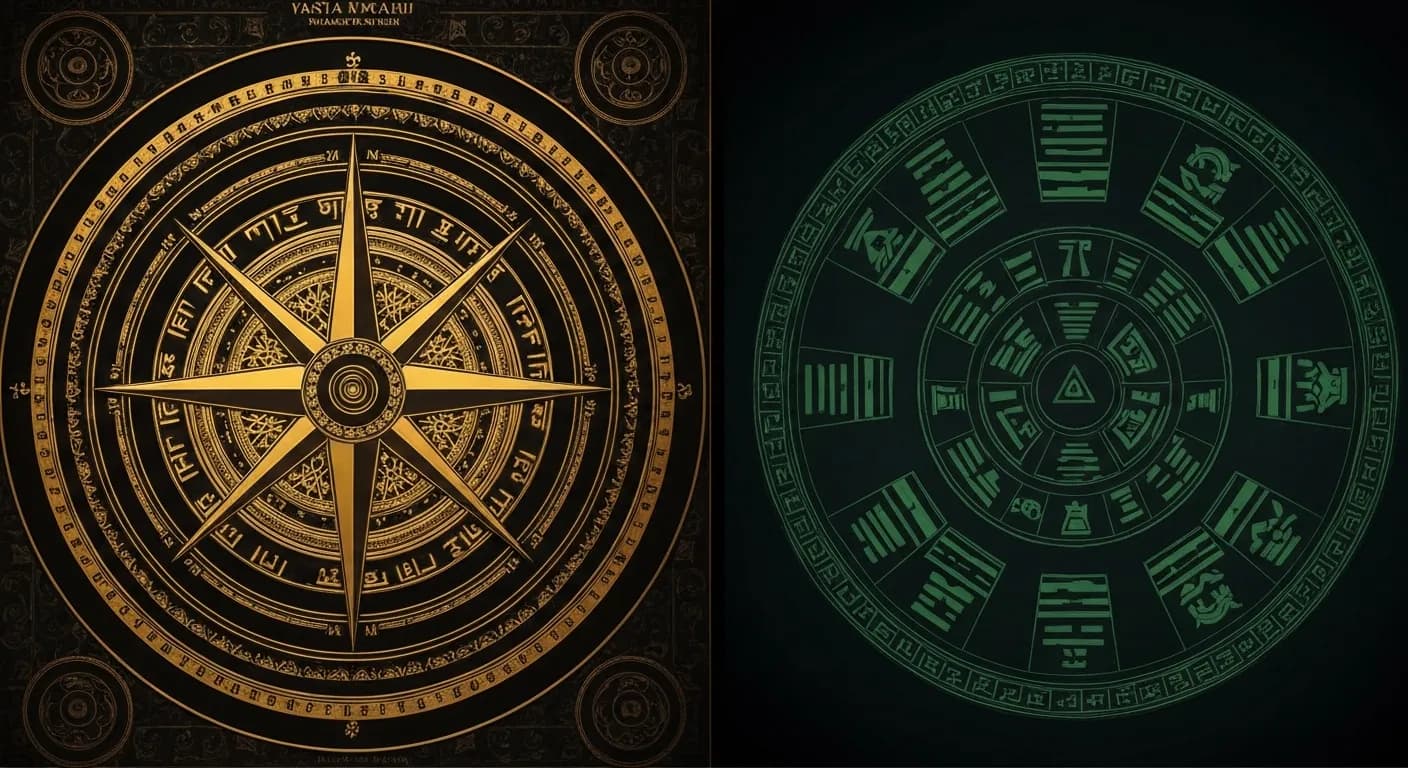
Vastu Shastra and Feng Shui are both ancient systems for harmonising living spaces, but they differ in origin, philosophy, and practice. This guide explains the key differences and how to choose — or combine — them.
Two Ancient Sciences of Space
Vastu Shastra and Feng Shui are the two most widely practised ancient systems for creating harmony between human beings and the spaces they inhabit. Both have survived thousands of years and continue to influence architecture, interior design, and everyday living decisions across the world. Both are based on the premise that the arrangement of built environments affects the health, prosperity, and wellbeing of their occupants.
Yet despite their surface similarities, Vastu and Feng Shui are distinct systems with different origins, different philosophical frameworks, different directional maps, and different practical applications. Understanding these differences is valuable whether you are choosing between them, working with a consultant, or simply trying to make sense of sometimes contradictory advice you have encountered.
Origins and Historical Context
Vastu Shastra originated in the Indian subcontinent and is among the world's oldest documented architectural sciences. Its principles are found in ancient Sanskrit texts including the Rigveda, the Arthashastra, and dedicated treatises such as the Manasara and Mayamata. The classical texts date from approximately 6,000 BCE, though the tradition itself is considered older. Vastu is intrinsic to Vedic culture and is closely related to Vedic astrology, sacred geometry, and Hindu cosmology.
Feng Shui originated in ancient China and has its roots in Taoist philosophy. The earliest recorded practices date to approximately 4,000 BCE. Feng Shui developed alongside Chinese astrology, the I Ching, and traditional Chinese medicine — all sharing the common framework of Qi (life force energy) and the interplay of Yin and Yang. The name itself translates as "wind-water," two of the most fundamental expressions of natural energy flow in Chinese cosmology.
Both systems thus emerged from sophisticated ancient civilisations with deep traditions of observing the relationship between natural forces and human wellbeing. Their differences reflect the distinct cosmological frameworks of these two cultures.
Philosophical Differences
Vastu Shastra is fundamentally cosmological and mathematical. It maps the built environment onto a cosmic diagram called the Vastu Purusha Mandala — a 9x9 (or sometimes 8x8) grid in which each zone corresponds to a specific deity, element, planet, and quality. The science is prescriptive: specific activities belong in specific zones based on their elemental nature. The goal is alignment between the human-made structure, the natural world, and the cosmic order.
Vastu operates with five elements (Pancha Bhoota): earth, water, fire, air, and space (ether). These elements are mapped to specific directions and zones, and the placement of rooms, entrances, and activities should respect and reinforce these elemental correspondences.
Feng Shui is fundamentally about the flow of Qi — life force energy. The central question is always: is energy flowing freely, stagnating, or rushing too quickly through this space? Feng Shui uses the Bagua map (eight trigrams from the I Ching) to overlay a grid of life areas (wealth, fame, relationships, family, etc.) onto a space, then assesses and enhances each area.
Feng Shui operates with five elements as well, but different ones: wood, fire, earth, metal, and water. These elements interact in productive and destructive cycles that guide the choice of colours, materials, and objects in each zone.
Directional Systems Compared
Both systems use the eight cardinal and intercardinal directions, but they assign different qualities to them.
In Vastu, the directions are governed by specific deities and planets: - North: Kubera (wealth), Mercury - East: Indra (abundance), Sun - South: Yama (justice), Mars - West: Varuna (cosmic order), Saturn - Northeast: Ishan (divine grace) — the most sacred corner - Southeast: Agni (fire) - Southwest: Nirrti (stability, earth) - Northwest: Vayu (air, movement)
In Feng Shui, the Bagua maps life areas to directions: - North: Career (water element) - East: Family and health (wood element) - South: Fame and reputation (fire element) - West: Children and creativity (metal element) - Northeast: Knowledge - Southeast: Wealth and abundance - Southwest: Relationships - Northwest: Helpful people and travel
A notable difference: Vastu places wealth in the north (Kubera), while Feng Shui places wealth in the southeast. Both systems would agree that activating the relevant zone supports financial wellbeing, but the specific direction — and therefore the part of your home that requires attention — differs.
Five Elements: A Direct Comparison
| Element | Vastu Shastra | Feng Shui | |---------|--------------|-----------| | Earth | Southwest, stability | Center, grounding | | Water | North, northeast | North, flow | | Fire | Southeast | South | | Air/Wood | Northwest | East, Southeast | | Space/Metal | Centre, east | West, Northwest |
The overlap is meaningful, particularly around water (north), fire (southeast in Vastu, south in Feng Shui), and earth (centre/southwest). The most significant divergence is Vastu's inclusion of space (ether) as a distinct element and the distinct roles of air and metal in the two systems.
When to Use Which — and Can They Be Combined?
Choose Vastu if: - You are of South Asian heritage and the system resonates culturally and spiritually. - You are working with a Vedic astrologer who integrates Vastu into horoscope analysis. - The specific Indian cosmological framework — deities, Sanskrit principles, the Vastu Purusha Mandala — feels aligned with your worldview. - You are in a region where Vastu expertise is widely available (India, UAE, Southeast Asia).
Choose Feng Shui if: - Chinese philosophical frameworks resonate more naturally with you. - You are working with a space or design professional trained in Feng Shui. - You want to focus specifically on life areas (career, relationships, wealth) using the Bagua approach.
Can they be combined? Yes, with care. The underlying principle — that spatial arrangement affects human wellbeing — is shared. Many practitioners draw on both, particularly for clients from multicultural backgrounds. However, attempting to apply both directional maps simultaneously can create confusion or contradiction. The most practical approach is to choose one system as the primary framework and use the other for supplementary insights.
At Trinergy, we practise Vastu Shastra within the broader Vedic framework that includes astrology and numerology. Our consultations consider your specific birth chart alongside your home's spatial configuration, because the most accurate guidance emerges when these dimensions are understood together rather than in isolation.
Transform Your Space with Vedic Vastu
Book a comprehensive Vastu Shastra consultation and align your home or office with the ancient science of harmonious living.